Let’s Welcome the Year of the Horse
Exploring lion dance traditions, costumes, movement and cultural learning — how young children discover Lunar New Year through hands-on, adult-guided play at Pegasus International Preschool.
Lunar New Year activities can give preschool children meaningful opportunities to explore cultural traditions through movement, music, costumes, storytelling and hands-on play. Rather than learning only through explanations, children may observe a lion dance head, touch its materials, try wearing parts of the costume and discuss what they notice.
In a multicultural preschool environment in Singapore, experiences such as these can help children become familiar with celebrations observed by families in the wider community. The activities may also support communication, confidence, coordination and imaginative play.
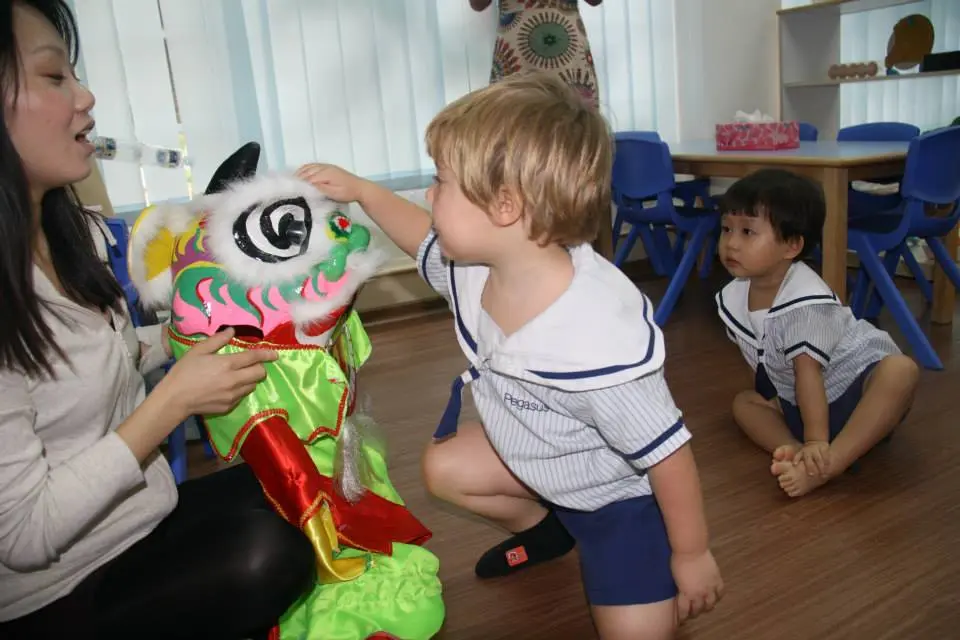
The photographs on this page capture children interacting with a colourful lion dance costume, listening to adult guidance and taking part in shared exploration. Through carefully supported participation, children may learn about cultural symbols while enjoying an active and memorable classroom experience.
Learning About Lunar New Year in Preschool
Lunar New Year is widely recognised in Singapore and is associated with family gatherings, festive decorations, traditional foods, music and community celebrations.
For preschool children, cultural learning is most meaningful when it is presented through concrete and age-appropriate experiences. A child may not yet understand the full history of a celebration, but can begin by noticing colours, sounds, clothing, symbols and familiar practices.
Activities may include:
Festive learning activities
- Looking at festive decorations.
- Listening to stories.
- Exploring lion dance props.
- Moving to music.
- Learning simple greetings.
- Comparing colours and patterns.
- Participating in dramatic play.
- Discussing family traditions.
These experiences can introduce children to culture without requiring them to memorise a large amount of information.
Exploring the Lion Dance Tradition
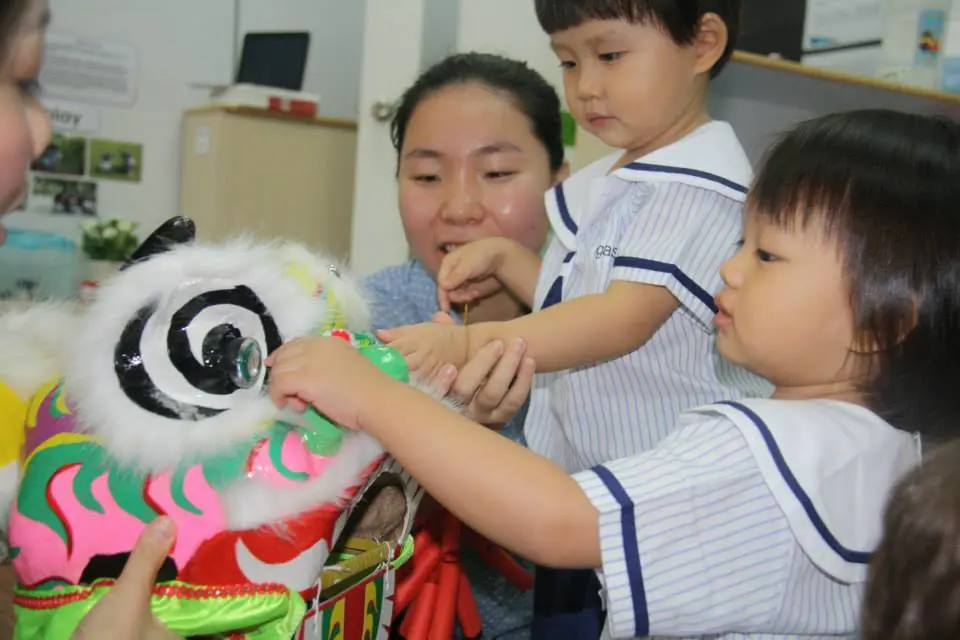
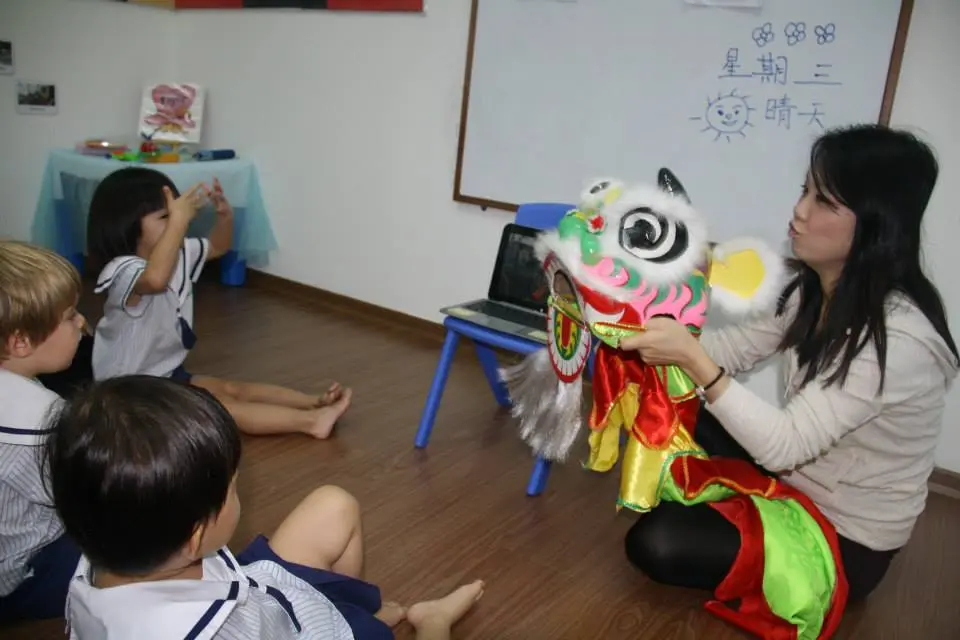
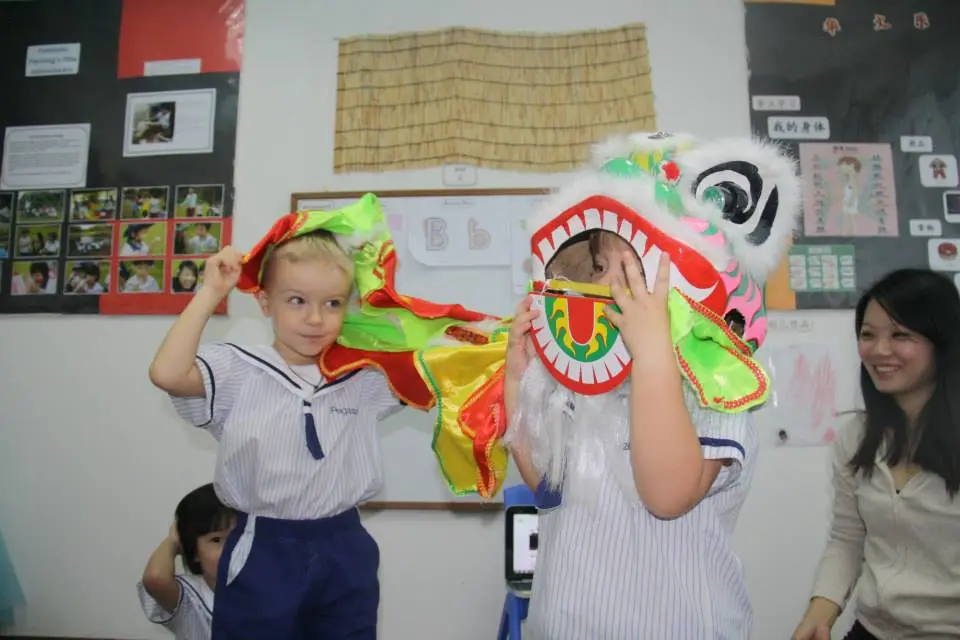
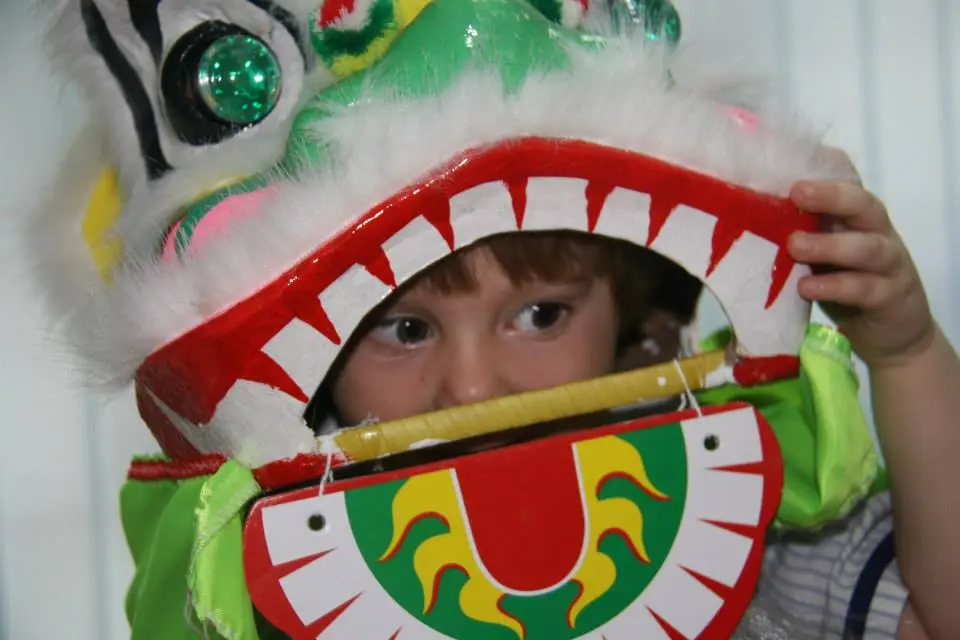
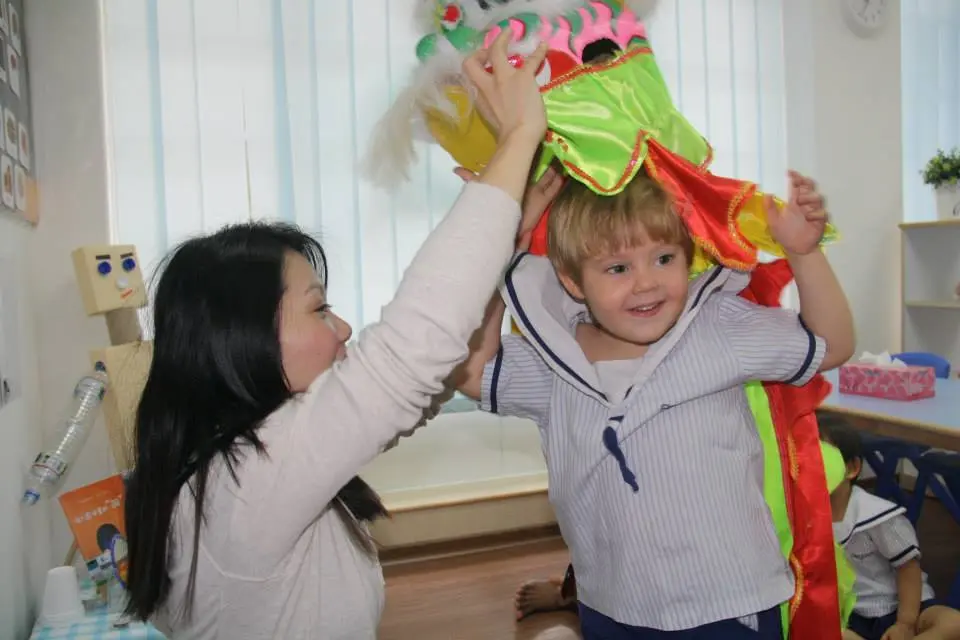
The photographs show children observing and interacting with a colourful lion dance head and costume.
Lion dance is often associated with Lunar New Year and other festive occasions. It combines music, coordinated movement, performance and visual symbolism.
For young children, the activity can begin with simple observation:
Questions to begin with
- What colours can you see?
- Where are the eyes?
- How does the mouth open?
- Which parts are soft or shiny?
- How might the lion move?
- What sounds might accompany the dance?
Children may be encouraged to touch suitable parts of the costume, look closely at the details and compare the prop with pictures or videos of a lion dance.
This allows the tradition to become more concrete and understandable.
Learning Through Real Objects and Cultural Materials
Real objects can make cultural learning more immediate.
A photograph or book can introduce a lion dance, but seeing and handling the costume gives children additional sensory information. They may notice its size, weight, texture, colours and moving parts.
The lion head may include:
Costume features
Teachers can draw attention to these features without overwhelming children with too much information.
The object becomes a starting point for observation, language, movement and imaginative play.
Supporting Curiosity Through Open-Ended Questions
Inquiry-based learning can be incorporated into cultural activities through thoughtful questions.
Instead of simply telling children every fact, teachers may ask:
Questions teachers may ask
- What do you notice first?
- Why do you think the eyes are so large?
- How might two people move together under the costume?
- What do you think the lion dance sounds like?
- Which part would be easy or difficult to carry?
- How is this different from a real lion?
- What might happen during a celebration?
These questions encourage children to observe, compare and suggest ideas.
The goal is not to test them. It is to invite conversation and help them engage more deeply with the experience. You can see how children learn through inquiry across everyday classroom activities.
Imaginative Play and Role-Playing
Trying on part of a lion dance costume can lead naturally to pretend play.
A child may imagine becoming the lion, moving through the room, opening the mouth or responding to music. Another child may prefer to watch before taking part.
Role-play can support:
Skills through role-play
Children may also take turns being the “head” or helping with the fabric. These roles require them to notice one another and coordinate their movements.
The activity does not need to reproduce a full traditional performance. A simplified classroom version can still provide meaningful creative and cultural learning.
Movement and Gross-Motor Development
Lion dance-inspired play involves large physical movements.
Children may bend, reach, lift, turn, crouch or move together while holding part of the costume.
These actions may support:
Gross-motor skills
The photographs show children standing under or beside the costume with adult support.
Teachers should adapt the activity to the children’s size and ability. Heavy or difficult sections should be handled by adults, while children participate with suitable parts. You can discover our play-based learning approach and how movement and costumes support active learning.
Fine-Motor Skills Through Handling Props
Cultural activities can also involve smaller hand movements.
Children may hold a handle, touch decorative features, adjust a piece of fabric or manipulate a simple handmade object.
These actions may support:
Fine-motor skills
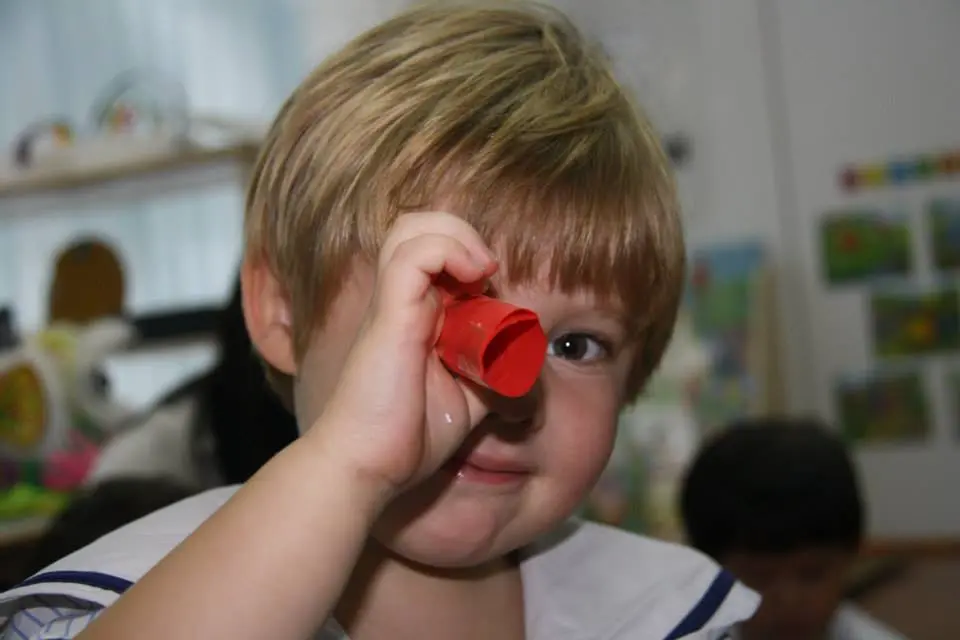
One photograph also shows a child looking through a small red tube. Although the exact purpose is not confirmed, using a simple object in this way can encourage visual exploration and controlled hand positioning.
Teachers may use safe props to extend observation and imaginative play.
Language Development Through Cultural Vocabulary
Lunar New Year activities provide natural opportunities to introduce new words.
Useful vocabulary may include:
Words children may hear
Children can hear these words while handling the costume and participating in the activity.
At Pegasus International Preschool, children receive exposure to English, Chinese and Japanese within the school environment. Cultural experiences may provide a meaningful context for hearing festive greetings and vocabulary in more than one language.
The emphasis should remain on understanding and communication rather than memorising isolated terms.
Social Learning Through Shared Participation
Group cultural activities help children learn how to participate with others.
They may need to wait for a turn, share a prop, listen to instructions or help a classmate.
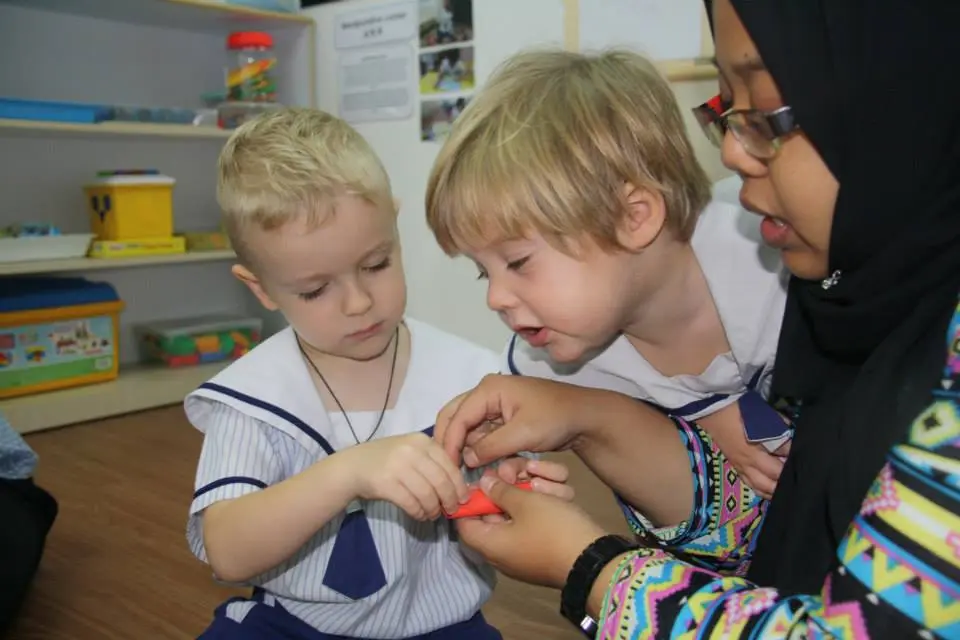
The photographs show children observing one another and engaging with adults during the activity.
Social skills may be supported through:
Social skills to practise
- Taking turns.
- Staying near the group.
- Sharing materials.
- Watching respectfully.
- Helping with a costume.
- Joining group movement.
- Expressing interest in another child’s turn.
Teachers can acknowledge that some children may want to participate actively while others may prefer to observe. Both can be valid forms of involvement.
Building Confidence in New Experiences
A large lion dance head may seem exciting to one child and unfamiliar to another.
Some children may approach immediately, while others may need reassurance. Teachers can introduce the prop gradually by allowing children to look, touch and watch before trying it on.
Helpful support may include:
Ways to support children
- Explaining what will happen.
- Showing the costume from different angles.
- Allowing children to touch it first.
- Letting adults demonstrate.
- Offering a turn without pressure.
- Keeping the child’s face visible.
- Removing the prop if the child becomes uncomfortable.
This helps children build confidence at a pace that suits them.
Cultural Learning in a Multicultural Preschool
Singapore is home to families from many cultural and language backgrounds.
Preschool cultural activities can help children become familiar with traditions beyond their own household. This may support respect, curiosity and openness.
Teachers can present Lunar New Year as one of several celebrations experienced within the wider community.
Useful approaches include:
Respectful teaching approaches
- Acknowledging that families celebrate differently.
- Avoiding assumptions about individual children.
- Focusing on shared learning.
- Using accurate and respectful language.
- Inviting families to contribute where appropriate.
- Presenting traditions without stereotypes.
The aim is to help children recognise diversity while understanding that cultural practices can vary from one family to another.
Connecting the Activity with Play-Based Learning
Play-based learning allows children to understand ideas through action and participation.
A lion dance activity may combine several areas of learning at once:
Physical development
Children move, bend, reach and coordinate their bodies.
Language
They hear and use words related to the costume, movement and celebration.
Social development
They take turns and participate with classmates.
Creative development
They imitate movement and invent stories.
Cultural awareness
They encounter a tradition observed in the wider community.
Inquiry
They examine how the costume works and ask questions.
The activity remains enjoyable while supporting connected learning across several domains. You can explore our preschool curriculum in Singapore to see how these connected experiences fit together.
Connection with the Reggio Emilia-Inspired Approach
A Reggio Emilia-inspired approach values children’s questions, observations and many forms of expression.
The lion dance costume can act as a rich learning material. Children may respond through:
Ways children may respond
A child who is interested in the eyes may later draw them. Another may focus on movement and create a dance. A group may build a simplified costume from paper and fabric.
The direction of learning can develop from what the children notice and find interesting. You can learn about our Reggio Emilia-inspired approach and its focus on many forms of expression.
Teachers may document comments, photographs and actions so the class can revisit the experience later.
The Teacher’s Role in Cultural Exploration
Teachers help make cultural activities safe, accurate and meaningful.
Their role may include:
Ways teachers help
- Selecting suitable materials.
- Explaining the cultural context simply.
- Modelling respectful handling.
- Supervising the costume.
- Introducing useful vocabulary.
- Asking open-ended questions.
- Helping children take turns.
- Supporting hesitant children.
- Connecting the activity with stories or music.
- Documenting children’s responses.
The photographs show adults guiding children closely as they explore the costume.
This support helps children remain active participants without being left to manage unfamiliar materials alone.
Extending Learning Beyond the Initial Activity
A lion dance experience can lead to other classroom activities.
Children may later:
Follow-up activities
- Draw the lion head.
- Compare patterns and colours.
- Listen to festive music.
- Practise simple movements.
- Create a paper lion.
- Build a costume with recycled materials.
- Tell a story about the lion.
- Learn a festive greeting.
- Watch a short age-appropriate performance video.
This allows the learning to continue rather than ending after one classroom session.
How Parents Can Continue Cultural Learning at Home
Parents can support cultural learning through simple and respectful experiences.
Families may:
- Read a book about Lunar New Year.
- Observe decorations in the neighbourhood.
- Watch a lion dance from a comfortable distance.
- Talk about the colours and sounds.
- Create a simple paper lion.
- Practise a festive greeting.
- Listen to traditional music.
- Discuss how different families celebrate.
Parents can ask:
Questions parents can ask
- What did you notice?
- Which part did you like?
- How did the lion move?
- Which colours did you see?
- What sound do you remember?
- What would you like to make?
The aim is to encourage observation and conversation rather than test the child’s memory.
Photo Gallery
The gallery below captures children learning about Lunar New Year through close observation, lion dance costume exploration, movement and adult-guided play. The photographs show moments of curiosity, confidence-building, cultural discovery and shared participation.
Frequently Asked Questions
What can preschool children learn from Lunar New Year activities?
Lunar New Year activities may support cultural awareness, language, social interaction, movement and creative expression. Children can learn through stories, costumes, music, decorations and hands-on play.
Why is lion dance exploration useful for young children?
A lion dance costume gives children a real object to observe and handle. They can explore colour, texture, movement and sound while developing vocabulary, coordination and confidence.
Are lion dance activities suitable for toddlers?
Yes, when the costume and activity are adapted to their age and closely supervised. Toddlers may begin by watching, touching selected parts and participating in simple movement.
How does cultural learning support inquiry-based learning?
Cultural materials can encourage children to ask questions, compare features and suggest explanations. Teachers may guide them through observation instead of providing every answer immediately.
How can parents introduce Lunar New Year traditions at home?
Parents can read stories, observe decorations, watch a child-friendly lion dance, make simple crafts and talk about festive colours, sounds and family practices.
Discover Cultural and Play-Based Learning at Pegasus
Cultural experiences can give children meaningful opportunities to observe, move, communicate and learn about the wider community. Through costumes, stories and hands-on exploration, children may develop curiosity while participating in a familiar and supportive preschool environment.