
Creative Learning at Our Novena Campus
Drawing, mark-making, sensory painting and supported indoor play — how young children explore materials, movement and colour at Pegasus International Preschool’s Novena campus.
Creative learning in preschool can take many forms, from making the first marks on paper to spreading paint with hands, experimenting with colours and moving across soft play equipment. These experiences allow children to explore materials through sight, touch and movement while expressing ideas in ways that do not depend entirely on words.
At a preschool in Singapore, hands-on activities can help make learning meaningful for toddlers and young children. A blank sheet of paper, a large painting surface or a soft indoor play structure may become an invitation to investigate, make choices and try something new.
The photographs on this page capture moments of focused mark-making, collaborative painting, sensory exploration and physical play at Pegasus International Preschool’s Novena campus.
Creative Exploration in the Preschool Environment
Creative learning is not limited to producing a recognisable drawing or a polished piece of artwork. For young children, the process of holding a marker, moving a hand across paper, spreading paint or noticing a new texture may be the most important part of the experience.
Activities such as these can give children opportunities to:
Opportunities for children
- Choose how to use a material.
- Repeat movements.
- Observe the marks they create.
- Explore colour and texture.
- Communicate through drawing and painting.
- Practise coordination.
- Work alongside an adult or classmate.
- Take part at a pace suited to them.
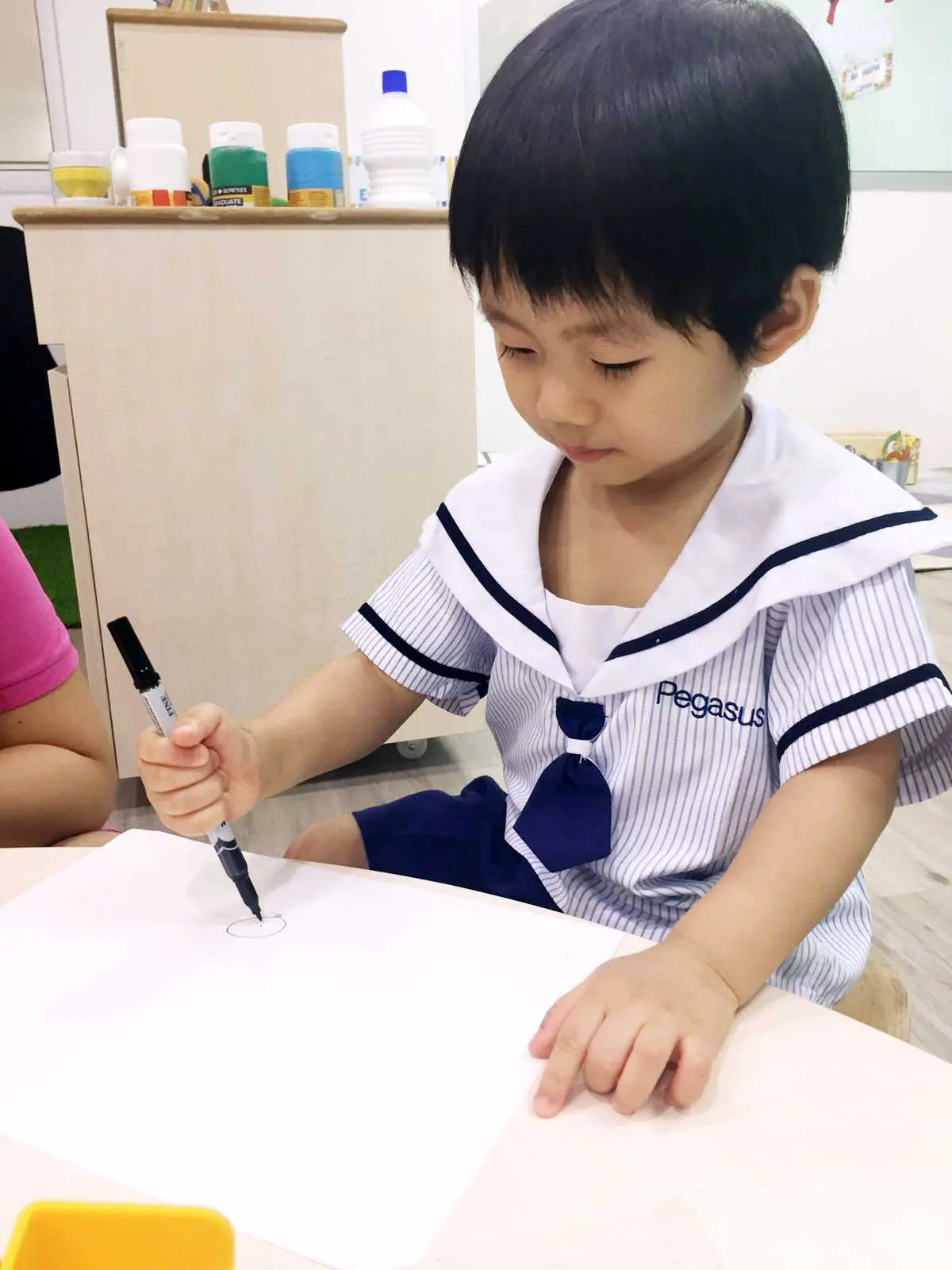
The photographs show different forms of participation. Some children appear deeply focused on drawing, while others explore paint across a large shared surface or engage with soft indoor equipment.
Early Mark-Making and Drawing
Mark-making begins before children are ready to form letters or draw detailed pictures. A line, circle, dot or repeated scribble can represent an important stage in learning how tools and movement affect a surface.
When a child holds a marker and moves it across paper, the child may begin to notice:
What children notice
- Pressing creates a visible mark.
- Moving quickly produces a different line from moving slowly.
- Circular movements create rounded shapes.
- Repeated actions can make a mark darker.
- Changing direction alters the pattern.
These discoveries support early control and visual awareness.
Adults may be tempted to ask what every drawing represents. However, some early drawings are investigations of movement rather than pictures of a specific object. A more helpful question might be, “How did you make that line?” or “What would you like to add next?”
Developing Fine-Motor Control
Drawing and painting involve coordinated movements of the hands, fingers, wrists and eyes.
Young children may still be experimenting with how to hold a marker. Their grip will gradually change as strength and control develop. The aim of an early activity should not be to enforce a perfect pencil grip before the child is ready.
Mark-making activities may support:
Skills supported
- Finger and hand strength.
- Wrist stability.
- Hand-eye coordination.
- Controlled pressure.
- Movement across a page.
- Use of one hand to steady the paper.
- Concentration over a short period.
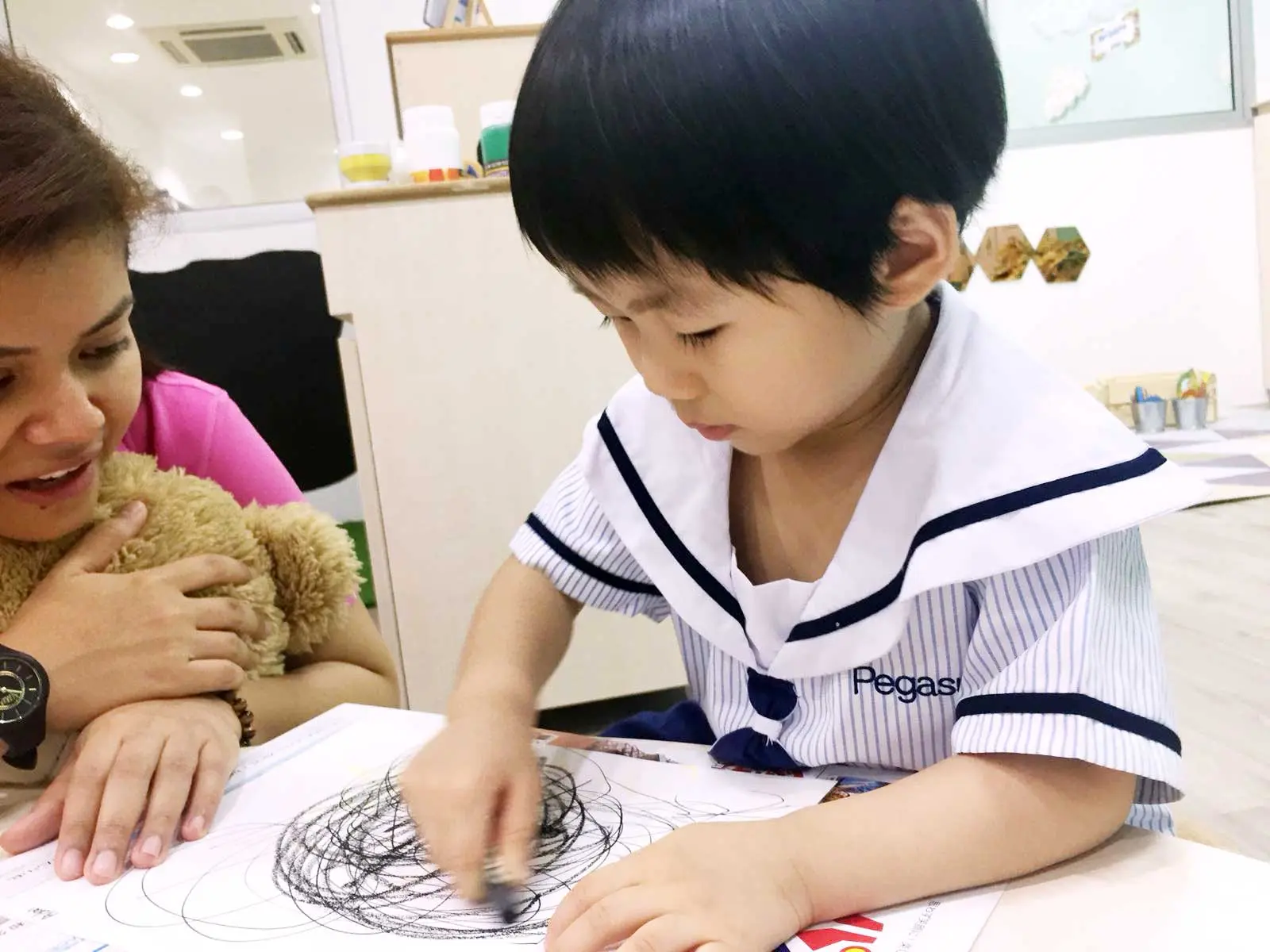
The photographs show children using drawing tools in different ways, including making small controlled marks and larger repeated circular movements.
These experiences can contribute to later drawing and writing development without turning the activity into formal handwriting practice.
Sensory Painting Through Touch and Movement
Painting can be explored with brushes, but children can also use their fingers, hands and other safe tools.
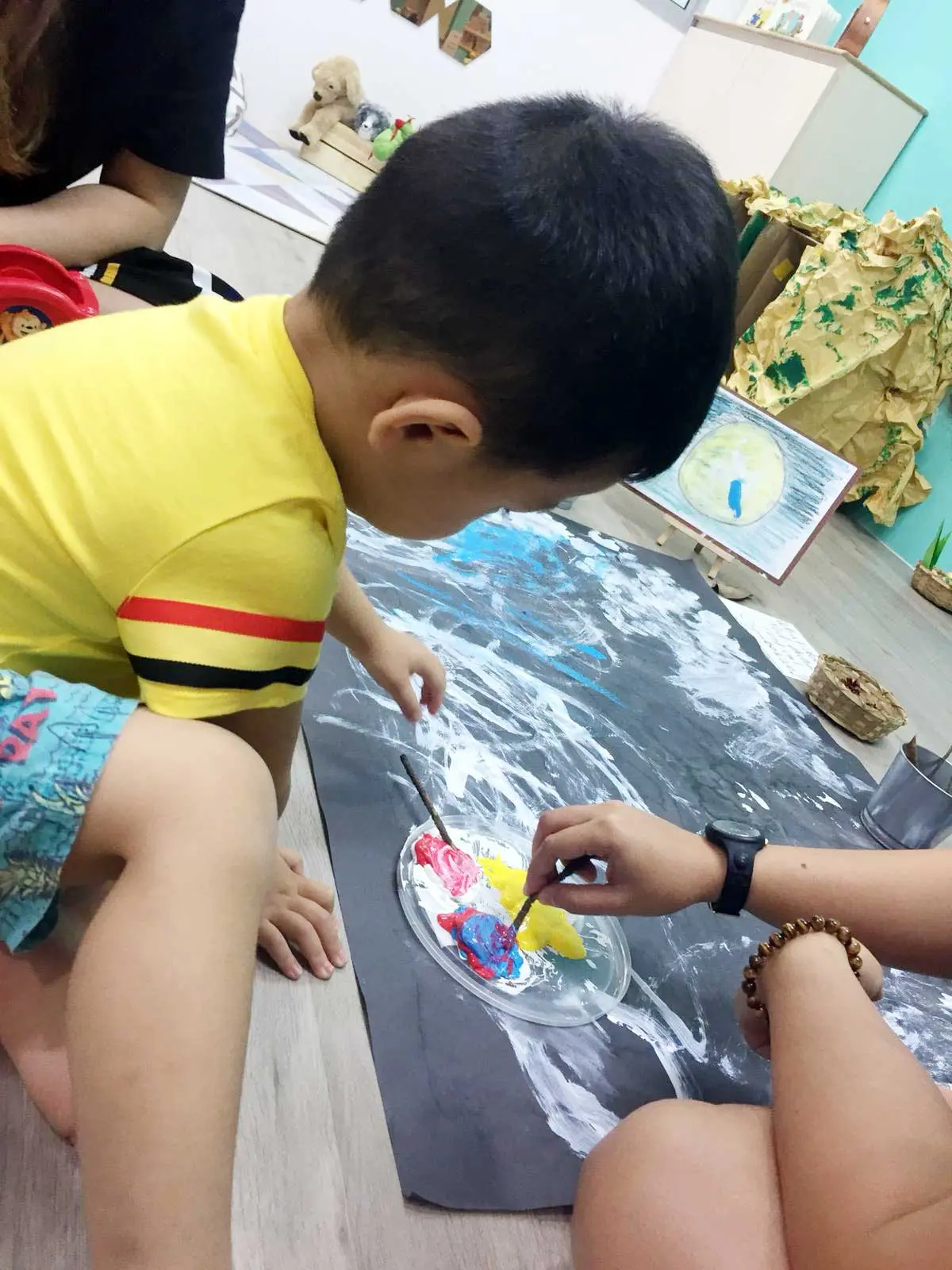
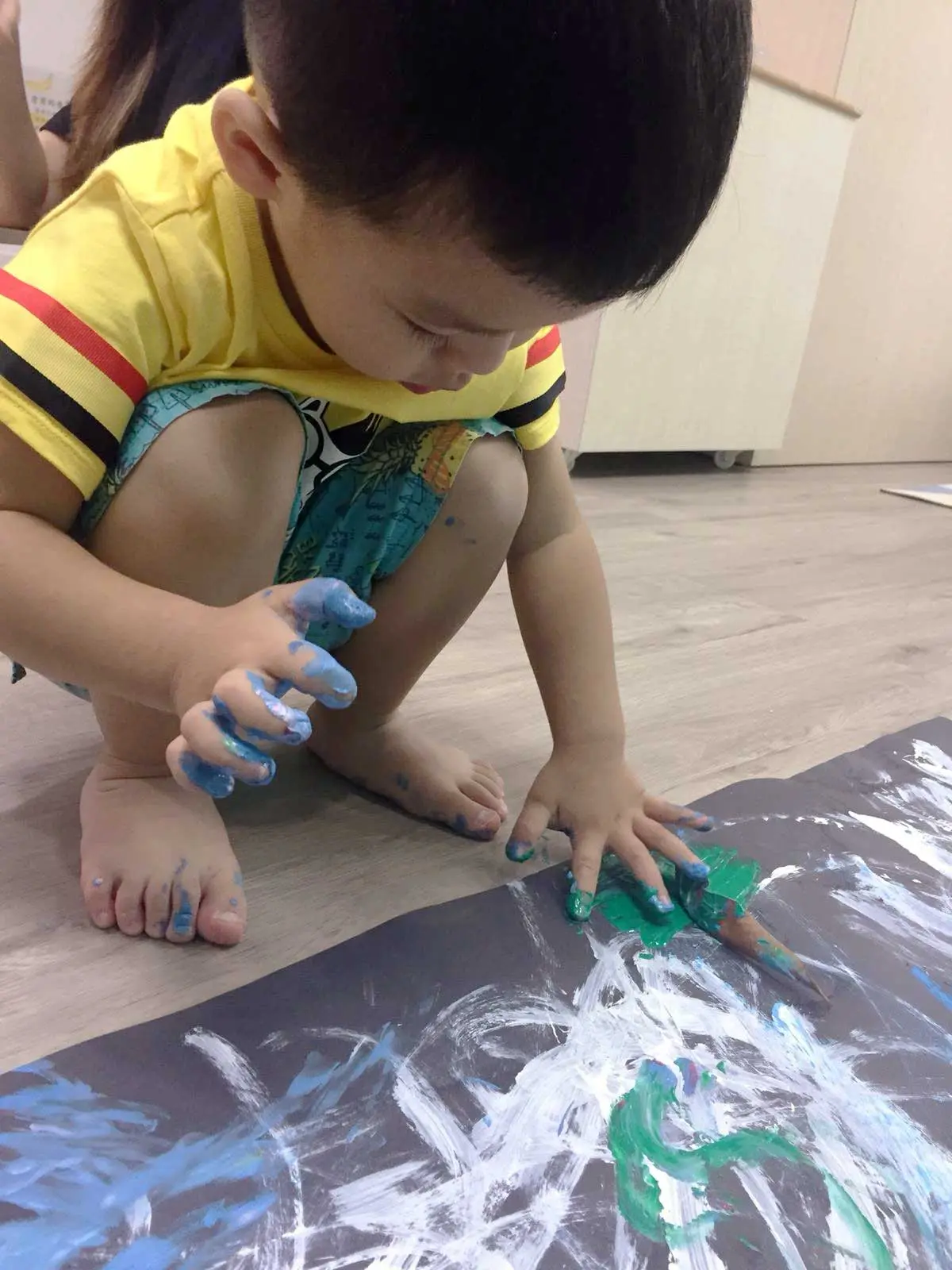
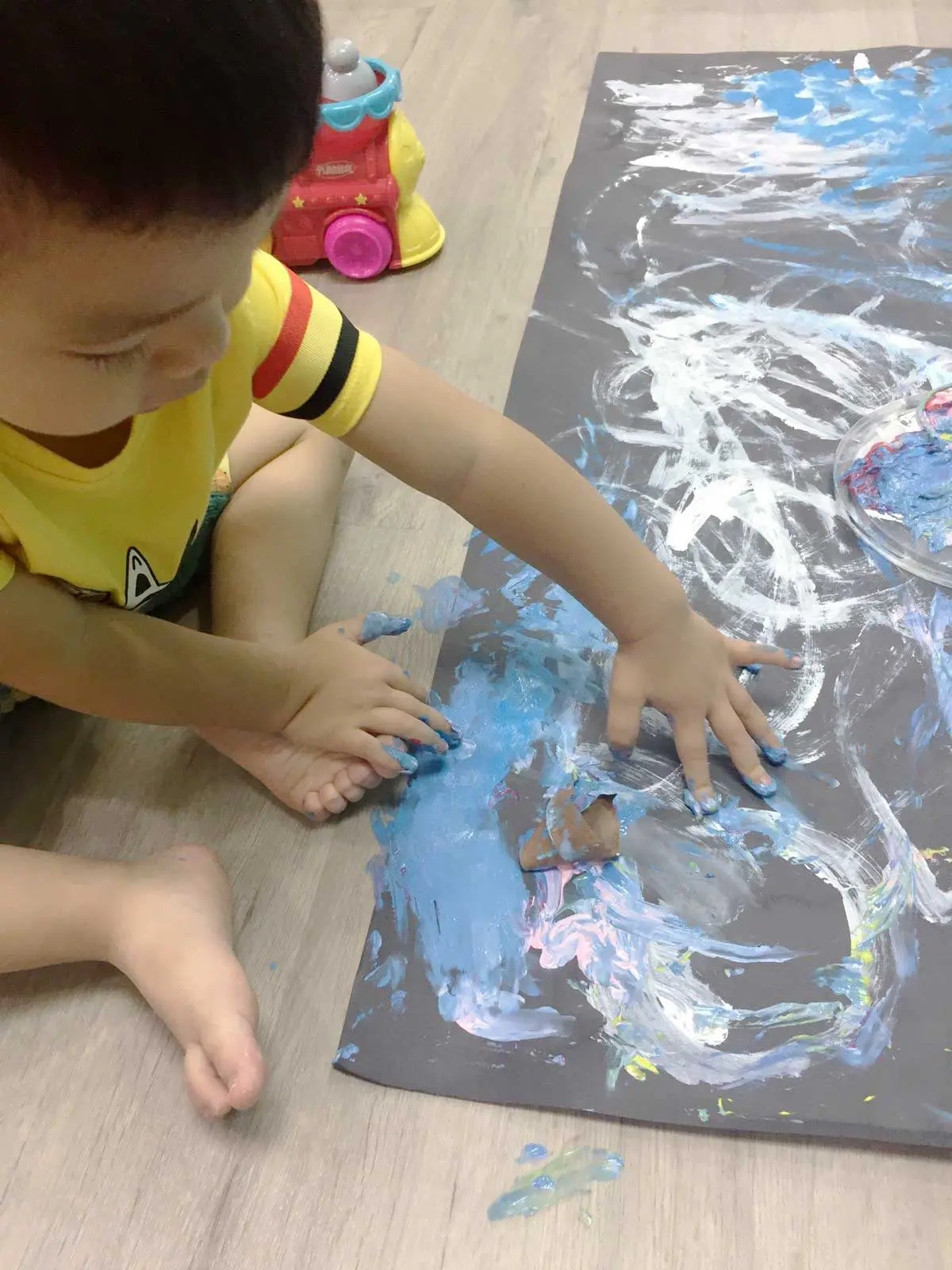
The gallery includes moments where paint appears to be spread directly across a large dark surface. Children may notice that paint feels cool, wet, smooth or slippery. They may observe how colours blend and how their hand movements leave visible paths.
Sensory painting can encourage children to explore questions such as:
Questions to explore
- What happens when two colours meet?
- How does the paint move under my fingers?
- Can I make a long line or a round shape?
- What happens when I press more firmly?
- How does the colour look on a dark background?
Not every child enjoys touching paint. Teachers can offer alternatives such as brushes, sponges or rollers and allow children to choose a comfortable way to participate.
Exploring Colour on a Large Surface
A large painting surface changes the way children interact with art.
Instead of using only small finger and wrist movements, children may reach, stretch and move the whole arm. They can work from different positions, including sitting, kneeling or leaning over the paper.
A shared surface may also encourage children to notice one another’s marks. One child may add blue paint beside another child’s white line. New colours and shapes may appear as different contributions overlap.
Large-scale painting can support:
Skills it supports
- Broad arm movements.
- Spatial awareness.
- Experimentation with direction.
- Awareness of personal and shared space.
- Collaborative participation.
- Observation of colour changes.
- Freedom to make larger marks.
The finished work may be less important than the physical and sensory process involved in creating it.
Learning Through Adult-Supported Exploration
The photographs show adults close to the children during several activities.
Adult support can help children feel secure while leaving room for independent action. A teacher may prepare the materials, model how to use them and step in when assistance is needed.
Helpful guidance may include:
Helpful guidance
- Showing how to hold an unfamiliar tool.
- Helping a child begin.
- Naming colours and movements.
- Asking open-ended questions.
- Keeping materials within reach.
- Observing before intervening.
- Acknowledging effort.
- Allowing the child to decide when the work feels complete.
An adult does not need to direct every mark. The child should remain the active participant rather than watching an adult complete the activity.
Inquiry Through Art Materials
Creative activities can also support inquiry-based learning. You can see how inquiry grows through exploration.
A child may test what happens when a marker is pressed lightly or firmly. During painting, the child may compare colours or try spreading paint with different parts of the hand.
These actions reflect early investigation. The child is forming an idea, taking an action and observing the result.
Teachers may extend the experience with questions such as:
Questions to extend thinking
- What do you notice?
- How did you make that shape?
- Which colour can you see now?
- What might happen if you add more paint?
- Is this mark the same as the previous one?
- Which tool would you like to try?
The aim is not to quiz children for correct answers. The questions invite them to pay attention and communicate what they are discovering.
Creative Expression and the Reggio Emilia-Inspired Approach
A Reggio Emilia-inspired approach recognises that children express ideas in many ways. Drawing, painting, movement, construction and sensory play can all function as forms of communication. You can learn about our Reggio Emilia-inspired approach.
A child may not yet have the language to explain an experience fully, but may communicate through repeated lines, colour choices, gestures or physical movement.
Art materials can therefore be presented as tools for thinking rather than simply supplies for producing a teacher-selected craft.
Teachers may observe:
What teachers observe
- Which materials attract the child’s attention.
- Whether certain movements are repeated.
- How the child responds to colour.
- How long the child remains involved.
- Whether the child watches or imitates others.
- What words or gestures accompany the activity.
These observations can help inform future learning invitations without making unsupported assumptions about what a specific drawing means.
Supporting Gross-Motor Development Indoors
Creative and sensory experiences can be complemented by physical play.
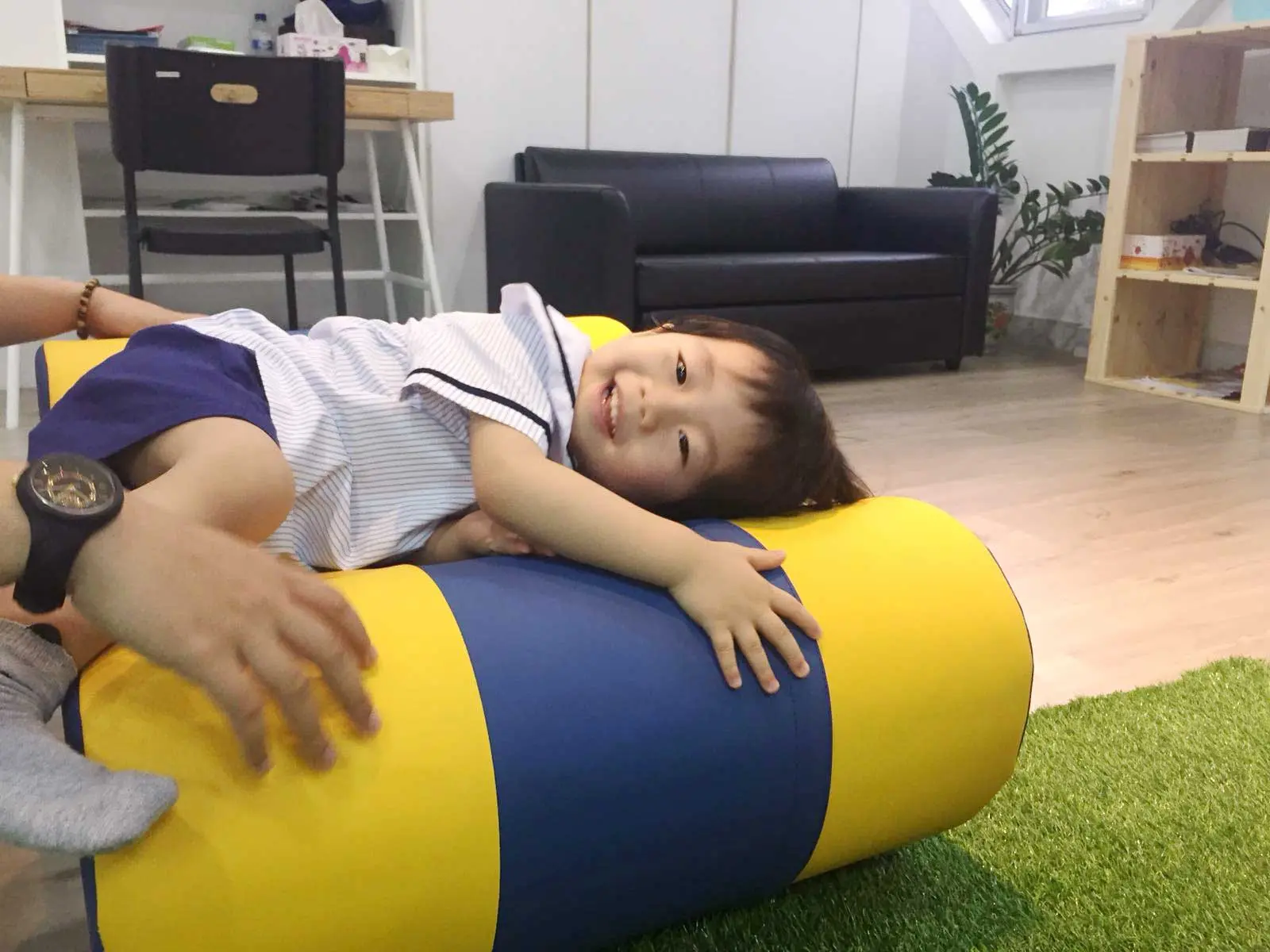
One photograph shows a child lying across a soft cylindrical play structure with adult support nearby. Activities involving soft indoor equipment may allow children to climb, lean, roll, balance or change body position in a controlled setting.
This type of movement can support:
What movement supports
- Body awareness.
- Balance.
- Core strength.
- Coordination.
- Confidence changing position.
- Awareness of space.
- Controlled movement on and off equipment.
Children develop physical confidence at different rates. Some may explore immediately, while others may first watch or require an adult’s hand.
Teachers can provide reassurance while allowing children to attempt suitable movements independently.
Connecting Art, Movement and Sensory Learning
Preschool learning often crosses several developmental areas at the same time. You can discover our play-based learning approach.
A painting activity may involve sensory exploration, language, physical coordination and decision-making. A movement activity may involve confidence, communication and problem-solving.
For example, a child spreading paint with both hands is not only creating an artwork. The child may also be:
Learning in action
- Coordinating both sides of the body.
- Judging how much pressure to use.
- Observing colour changes.
- Responding to texture.
- Occupying space beside another child.
- Communicating through gestures or words.
This integrated learning is one reason hands-on experiences are valuable in the early years.
Language Development During Creative Activities
Art and movement activities create natural opportunities for conversation.
Teachers can introduce words connected to what the child is doing, such as:
Words to introduce
The words become easier to understand when they are connected to an immediate action.
At Pegasus International Preschool, exposure to English, Chinese and Japanese can be incorporated naturally into familiar routines and activities. The focus should remain on meaningful communication rather than asking children to memorise isolated terms.
Confidence, Choice and Independence
Creative experiences allow children to make manageable choices.
They may choose a colour, decide where to begin, select a tool or determine how long to continue. These decisions can support a growing sense of independence.
Teachers can offer choices without overwhelming children. For example:
Offering simple choices
- Would you like the black or blue marker?
- Would you like to use your fingers or a brush?
- Would you like to sit at the table or work on the floor?
- Would you like some help to begin?
The activity does not need to produce the same result for every child. Differences in approach are expected and can be welcomed.
Continuing Creative Learning at Home
Parents can support similar exploration using simple materials. You can explore our preschool curriculum in Singapore.
Suitable options may include:
- Large sheets of paper.
- Washable markers.
- Crayons.
- Child-safe paint.
- Cardboard.
- Sponges.
- Recycled paper.
- Old clothing as protective art wear.
- A washable mat or covered table.
Parents might place one or two materials within reach and allow the child time to investigate.
Useful comments and questions include:
Comments and questions
- I can see you made a long line.
- What colour would you like next?
- How does the paint feel?
- What happened when the colours mixed?
- Would you like more paper?
- Tell me about what you are doing.
It is often more helpful to notice the process than to praise only the finished result. Comments about effort, movement and choices show that the child’s exploration is being taken seriously.
Photo Gallery
The gallery below captures children taking part in drawing, mark-making, sensory painting and indoor physical play at the Novena campus. The photographs show moments of concentration, colour exploration, hands-on discovery and supportive interaction with adults.

Frequently Asked Questions
What do children learn from early drawing and mark-making?
Early mark-making may help children develop hand strength, coordination, visual awareness and control of drawing tools. It also gives them a way to experiment and express ideas before they are ready to form recognisable pictures or letters.
Why is sensory painting useful for preschool children?
Sensory painting allows children to explore colour, movement and texture through direct experience. It may support descriptive language, hand-eye coordination, creativity and early understanding of cause and effect.
Is finger painting suitable for toddlers?
Finger painting can be suitable when washable, child-safe materials are used under close supervision. Children who do not enjoy touching paint can be offered brushes, sponges or other tools instead.
How does creative play connect with inquiry-based learning?
Creative play encourages children to test what materials can do. They may change pressure, mix colours, repeat movements and observe the results. Teachers can extend this thinking through open-ended questions.
How can parents encourage mark-making at home?
Parents can provide large paper, washable crayons or markers and enough time for open-ended drawing. Rather than asking only what the picture is, they can comment on the lines, colours and movements the child is using.
See Hands-On Learning at Pegasus
Drawing, sensory painting and movement give children different ways to investigate, communicate and build confidence. Visit the school to explore the learning spaces, speak with the team and find out which programme may be suitable for your child.