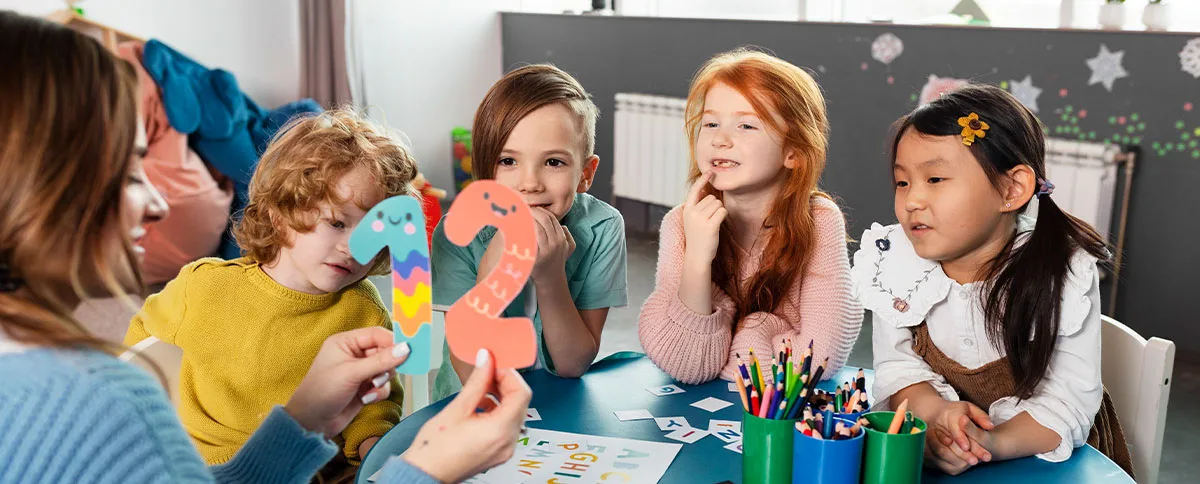

Long before children have the words for their feelings, they are already feeling them deeply. A gentle question at the right moment gives a young child a way to notice what is happening inside, to put it into words, and to feel understood. The aim is never to test your child or to fix everything at once — it is simply to open a small, safe door to conversation.
Some children talk readily; others need time, or would rather show you through drawing or play. Both are perfectly fine. When you ask with warmth and patience, you are quietly teaching your child that feelings are welcome here, and that they never have to carry a big feeling alone.
Best suited for
Nursery 1, Nursery 2, Kindergarten 1 and Kindergarten 2 — adapt the wording to suit your child’s age.
How young children experience emotions
It helps to remember a few things about how feelings work at this age. Young children often:
- feel an emotion before they have the language to describe it;
- use behaviour — not just words — to communicate how they feel;
- need a little time before they are ready to talk;
- give short or unexpected answers;
- prefer drawing or play to a direct conversation.
Because of this, it is best not to press a child to speak the moment something happens. A calm presence, and the offer of a question rather than a demand, works far better than insisting on an immediate answer.
Start with everyday emotional check-ins
Emotional conversations flow more easily when they are a normal part of ordinary days, not something that only appears after a problem. A quiet question at bath time, on a walk or at bedtime keeps the door open. You might try:
- What made you smile today?
- What made you feel proud today?
- Was there anything that made you feel worried?
- Who made you feel happy today?
- How did you help someone today?
- What helped you feel calm?
Move beyond “How was school?”
“How was school?” often earns a one-word reply, because it is a very big question. Smaller, more specific questions give children something to hold on to:
- Was there a moment when you felt brave?
- Did anything make you frustrated or disappointed?
- What happened just before you felt that way?
- What would have helped?
- Where did you feel that feeling in your body?
- What would you like someone else to understand?
If your child is just settling into preschool, gentle check-ins like these are especially reassuring; our guide on supporting a child through first-day separation anxiety offers more ideas for those early weeks.
Help children name their feelings
Naming a feeling helps to tame it. When you offer the words, you give your child a way to understand the storm inside rather than being swept along by it. A simple palette of familiar feelings is a good place to start:
- happy
- excited
- proud
- worried
- sad
- frustrated
- angry
- disappointed
- calm
- brave
You might say, “You look really frustrated that the tower fell down — that’s hard,” and then pause. Over time, a child who has heard their feelings named again and again begins to name those feelings for themselves.
Listen without immediately fixing
When a child shares something difficult, our instinct is often to solve it straight away. Yet children usually need to feel heard first. It helps to notice the difference between:
- Listening — staying quiet, nodding, letting your child finish.
- Correcting — jumping in to say what really happened.
- Lecturing — turning the moment into a lesson.
- Solving too quickly — offering answers before your child has finished feeling.
A little patience here builds trust, and it is closely linked to the everyday emotional support children receive at school; you can read how we approach this in our article on building emotional resilience in the early years.
Help your child think about what comes next
Once a child feels understood, they are far more open to thinking about a way forward — gently, and with you alongside them:
- What could help now?
- Would you like some help, or a little quiet time?
- What could you try next time?
- Who could you speak to?
When the feeling involves a disagreement with a friend, these same steps make room for repair; our guide to guiding children through conflict explores that in more detail.
A closing thought
Helping a child talk about feelings is slow, gentle work, and it happens a little at a time. You will not always get a full answer, and you do not need to. Each small, unhurried conversation tells your child the same reassuring thing: your feelings make sense, and I am here to listen.