“Is my child developing well?” is a question many parents begin asking more seriously between the ages of two and three. It is often accompanied by a handful of smaller, more specific worries: Should my two-year-old be talking more? Why does my child cry instead of telling me what is wrong? Why won’t my three-year-old share? Should my child be playing with other children already? These are good questions, and they deserve a more useful answer than a checklist.
Why Does Development Look So Different From Child to Child?
At this age, development can look very different from one child to another, and progress is often easier to see in small changes over time than in a list of achievements reached by a certain month.
A child who once cried when they wanted something may begin pointing, saying “help” or using a short sentence. A child who previously played mainly beside other children may start watching them, copying their ideas and gradually joining their play. A child who shouted “No!” when frustrated may begin saying “Mine,” “My turn,” or “I don’t like it.”
These may seem like small moments. They show important growth in language, emotional understanding, social interaction and independence.
Should My Two-Year-Old Be Talking More?
Spoken words are only one part of how a two-year-old communicates. Pointing, leading you by the hand, bringing you an object, using a sound consistently for the same thing — these are all communication, and they usually arrive before sentences do.
What is worth watching is not the size of the vocabulary on any given week, but whether the range of ways your child communicates is widening. Are new words appearing, even slowly? Are gestures becoming more deliberate? Does your child respond when you talk about something you are both looking at?
If you have a concern about your child’s speech or hearing, it is always reasonable to raise it with your doctor rather than wait and see. Describe what you notice at home; that observation is genuinely useful information.
Why Does My Child Cry Instead of Telling Me What Is Wrong?
Because at two, the feeling almost always arrives before the words do. Crying is not a failure to communicate — it is the communication, used because it is the tool currently available.
The gradual shift you are looking for is from crying alone, towards crying and reaching for you, then towards a gesture, then towards a word such as “help” or “more.” We look at this more closely in our guide to why emotions are not problems to be solved.
Why Won’t My Three-Year-Old Share?
Sharing asks a great deal of a young child at once: noticing what someone else wants, holding on to their own wish, waiting, and trusting that the object will come back. Those are separate skills, and they mature at different rates.
Turn-taking, with an adult nearby to help, is usually a more realistic step than spontaneous sharing. “One more turn, then it is Aisha’s turn” gives a child something concrete to hold on to. Over months, that scaffolding becomes something they can do without you.
Should My Child Be Playing With Other Children by Now?
Playing near other children is a developmental stage in its own right, not a lesser version of playing with them. Many children spend a long time watching before they join in, and watching is rarely passive — it is how a child works out what the game is.
What you are looking for is movement along that line: more noticing, more copying, more offering of an object, more tolerating another child close by.
How Do Children This Age Actually Learn?
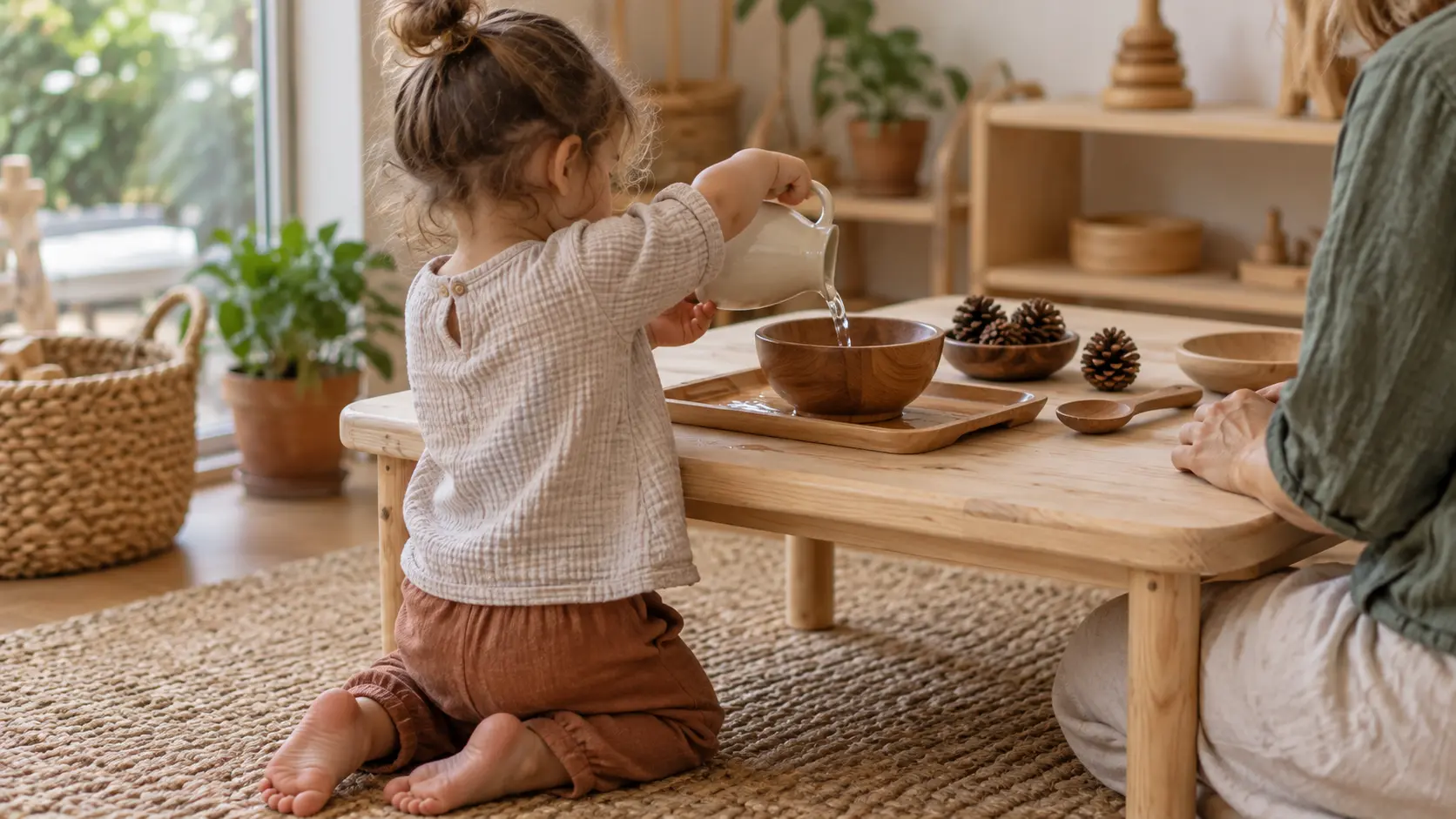
For children aged two to three, learning happens through conversation and hands-on exploration.
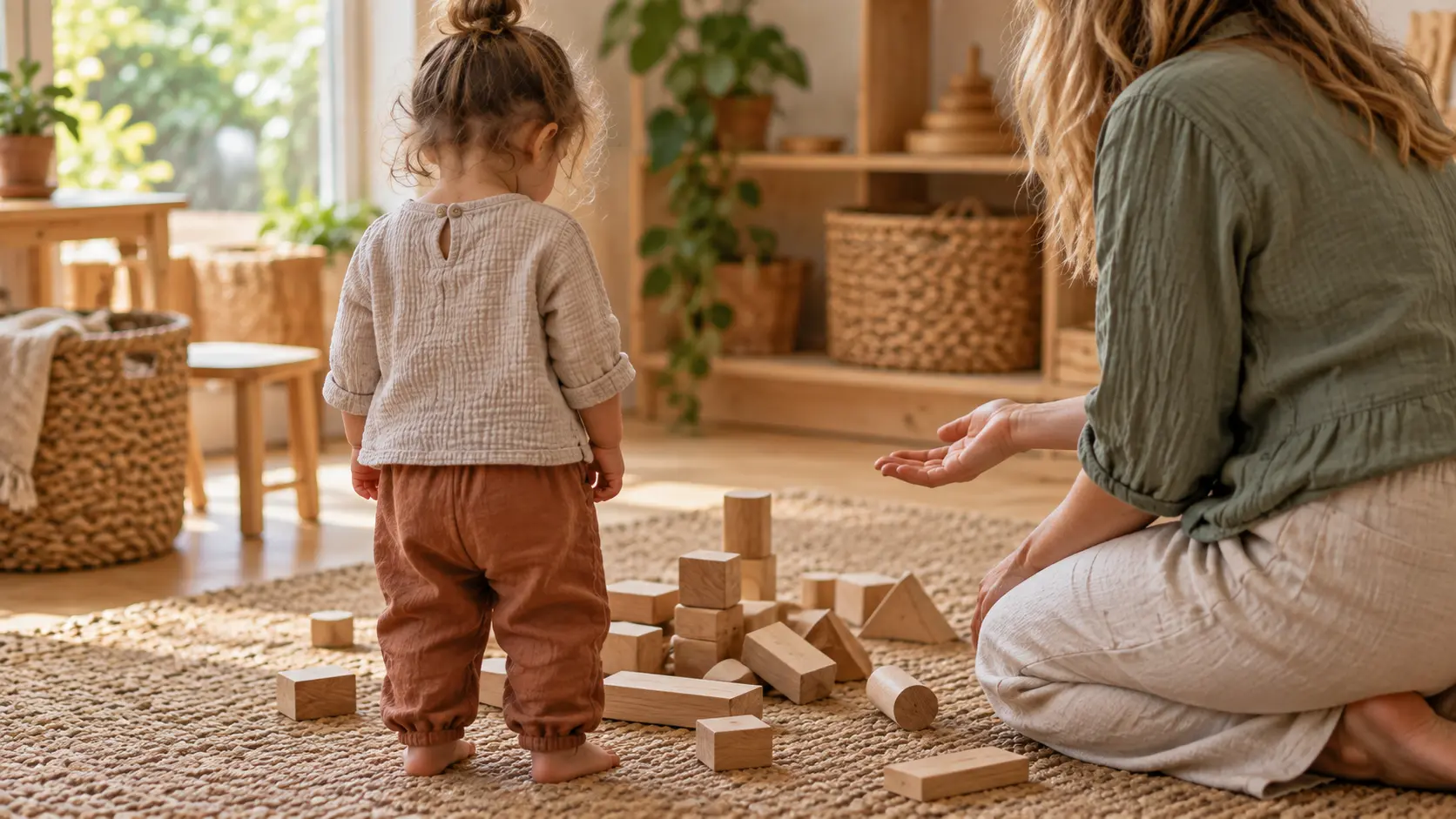
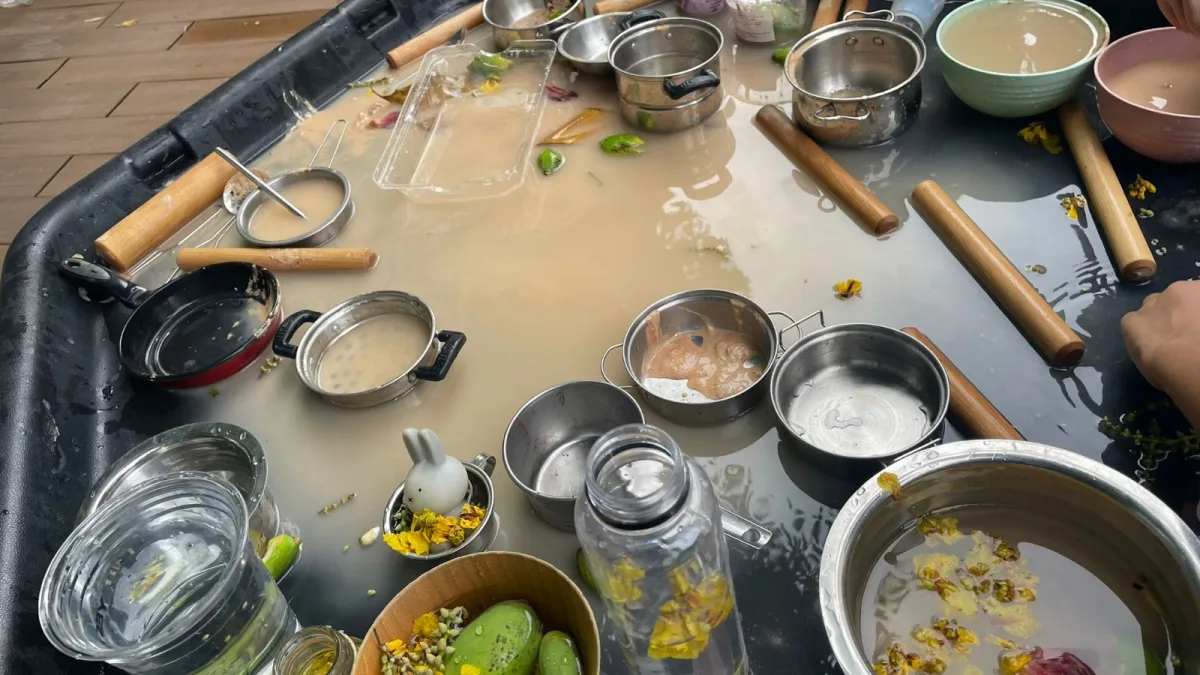
Imagine several children exploring water, leaves and containers together. One child says “more,” another notices that a leaf is floating, while a third watches a friend pour water and decides to try the same thing. Or children build with wooden blocks, count pieces with a teacher, make marks on paper and use new words such as big, small, high, fall, again.
In a Reggio Emilia–inspired environment, children can communicate through many forms — not only spoken language, but also movement, drawing, construction, sensory exploration and early mark-making. This matters particularly at two and three, because a child may understand far more than they can yet explain in words.
What Does “Developing Well” Look Like Day to Day?
Rather than measuring against a milestone chart, it can help to ask a handful of open questions:
- Is your child finding more ways to tell you what they want?
- Are new words and ideas appearing?
- Are they becoming interested in what other children are doing?
- Can they explore something for a little longer, try again, make a choice, or ask for help?
- When upset, are they moving gradually from only crying or shouting towards gestures and simple words such as “help,” “my turn,” “more,” “no,” or “I want…”?
None of these has to be true every day. Development is uneven, and a tired or unwell week can look like a step backwards without being one.
A Better Question Than “Is My Child on Track?”
At two and three years old, development is not about how quickly a child reaches the next milestone. A more meaningful question is this: compared with a few months ago, is my child finding more ways to understand, communicate, connect and explore the world?
That is where some of the most important early development becomes visible — and it is a question you, who sees your child every day, are unusually well placed to answer. If you are also weighing up what comes next, our guide to nursery and kindergarten in Singapore explains how the stages fit together.
See How Your Child Explores at Pegasus
At Pegasus International Preschool in Novena, our educators observe closely and document what children are working on, so that progress is visible in real moments rather than in a checklist. You are welcome to see that for yourself — book a free, no-obligation school tour and bring your child along.